
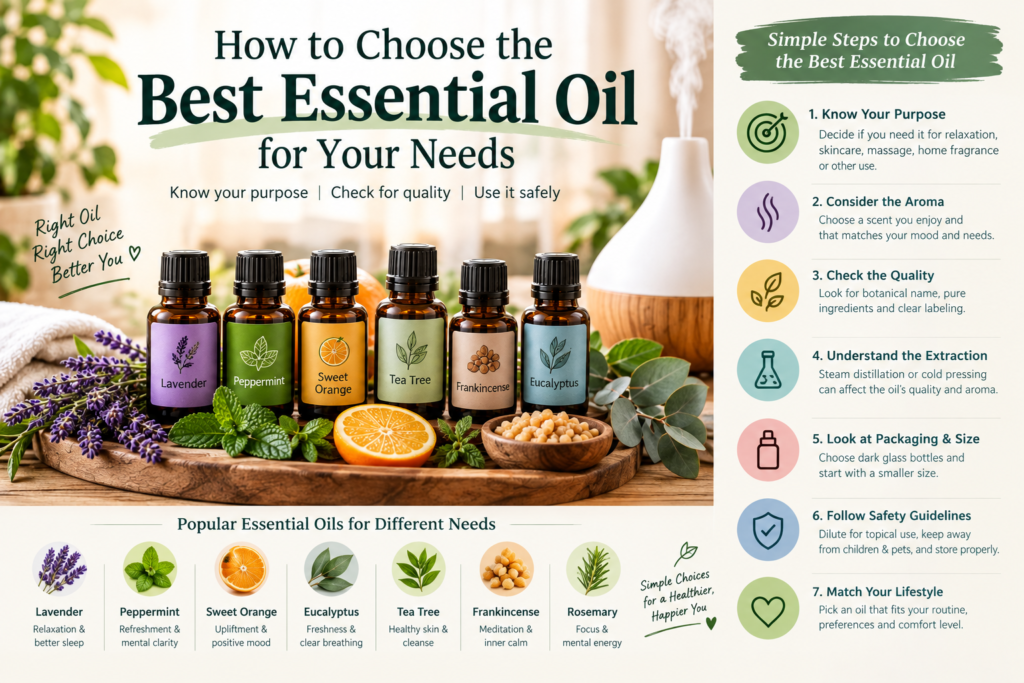
Essential oils have become a popular part of modern wellness, aromatherapy, skincare, massage, and home-care routines. With hundreds of aromatic oils and countless products available today, choosing the right one can sometimes feel confusing. Lavender, peppermint, eucalyptus, lemon, sweet orange, tea tree, frankincense, rosemary, and many other oils offer very different aromas and uses.
The key is to understand what you actually need before choosing a product. The best essential oil for relaxation may not be the right option for skincare, while an oil that works well in a diffuser may not be suitable for direct topical use.
Choosing an essential oil should involve more than simply looking at popularity or price. You should consider the purpose, aroma, ingredients, quality, extraction method, packaging, and safety instructions.
Whether you are completely new to aromatherapy or already have a small collection of oils, this guide will help you understand how to select an oil that fits your preferences and lifestyle.
What Are Essential Oils?
Essential oils are concentrated aromatic substances obtained from plants. Depending on the plant, the oil may be extracted from flowers, leaves, fruits, peels, bark, roots, seeds, or other botanical materials.
Each oil has a distinctive chemical composition and fragrance profile.
For example, lavender has a soft floral aroma, peppermint has a strong minty fragrance, lemon provides a bright citrus scent, and cedarwood has a warm woody character.
Essential oils are highly concentrated, which means they should be handled carefully. They are different from ordinary perfume oils, fragrance oils, and carrier oils.
Before deciding which product is right for you, it is useful to understand why you want to use it.
Start by Identifying Your Main Purpose
The first question to ask is: What do I want to use this oil for?
Your answer can immediately narrow your choices.
You may be interested in essential oils for:
- Relaxation
- Meditation
- Aromatherapy
- Home fragrance
- Massage
- Personal-care products
- Skincare routines
- Hair-care routines
- Creating aromatic blends
- A refreshing home environment
For example, someone looking for a calming evening aroma may prefer lavender, while someone who enjoys fresh and energetic scents may prefer peppermint or citrus oils.
The best essential oil should match your intended purpose instead of being selected simply because it is trending.
Consider the Aroma
Aroma is one of the most important factors when choosing an essential oil.
A scent that one person finds relaxing may be too strong or unpleasant for another person. Personal preference matters because aromatherapy is primarily a sensory experience.
Floral aromas
Lavender and ylang-ylang are examples of floral oils. They are often selected for relaxation-focused environments and personal-care products.
Citrus aromas
Lemon, sweet orange, grapefruit, and bergamot offer fresh, bright fragrances.
Minty aromas
Peppermint and spearmint have cool, refreshing scents.
Woody aromas
Cedarwood and sandalwood-inspired aromatic products offer deeper, earthy fragrance profiles.
Resinous aromas
Frankincense has a warm, resinous character that many people associate with meditation and traditional aromatic practices.
Try to choose an aroma that you genuinely enjoy. You are more likely to use it consistently when the fragrance suits your preferences.
Popular Essential Oils and Their Characteristics
Understanding common oils can make your selection easier.
Lavender Essential Oil
Lavender is one of the most recognizable essential oils. It has a soft floral and slightly herbal aroma and is commonly used in relaxation, bedtime, massage, and personal-care routines.
It is also frequently included in blends because it combines well with citrus, woody, and other floral aromas.
Peppermint Essential Oil
Peppermint has a powerful, fresh, minty fragrance.
It is commonly used in refreshing aromatherapy routines and home fragrance blends.
Because the aroma can be intense, it is generally better to start with a small amount rather than assuming more will be better.
Sweet Orange Essential Oil
Sweet orange offers a pleasant fruity-citrus aroma.
It is often used in home fragrance and aromatherapy blends and can pair nicely with lavender, cinnamon, frankincense, and other oils.
Lemon Essential Oil
Lemon has a bright and clean citrus fragrance.
It is popular in diffusers and aromatic household products. As with other citrus oils, topical-use precautions should be checked carefully before application.
Eucalyptus Essential Oil
Eucalyptus has a distinctive fresh, sharp, camphoraceous aroma.
It is commonly found in aromatic shower products, diffusers, and refreshing blends.
Its strong scent means that careful use is important.
Tea Tree Essential Oil
Tea tree has a strong herbal and medicinal-style fragrance.
It is commonly included in personal-care and cosmetic formulations.
When used topically, appropriate dilution and product instructions should be followed.
Frankincense Essential Oil
Frankincense has a warm, resinous and slightly woody fragrance.
It is commonly associated with meditation, mindfulness, and traditional aromatic practices.
Rosemary Essential Oil
Rosemary offers a fresh herbal and woody aroma.
It is often selected for daytime aromatic routines and can be combined with citrus or minty oils.
Check the Product Label
One of the simplest ways to evaluate an essential oil is to read its label carefully.
A clear product label should provide useful information such as:
- Common plant name
- Botanical name
- Plant part used
- Ingredients
- Net quantity
- Manufacturer information
- Batch or lot information where applicable
- Usage instructions
- Safety precautions
Avoid choosing a product solely because its packaging uses words such as “premium,” “pure,” or “natural.”
Marketing language alone does not tell you everything about product quality.
Look for brands that provide transparent and practical information.
Why Botanical Names Matter
The botanical name can help identify the exact plant species or variety used in a product.
Common names can sometimes refer to multiple related plants, while botanical names provide more specific identification.
For experienced aromatherapy users, this information can be especially useful when comparing products.
If a manufacturer provides detailed botanical information, it can help you understand exactly what you are purchasing.
Understand the Ingredients
Before buying an essential oil, check whether it is a pure essential oil or a pre-diluted product.
Some products are sold as concentrated essential oils, while others are already mixed with carrier oils.
Neither format is automatically better. The important thing is knowing what is actually inside the bottle.
If you are purchasing an oil specifically for diffusion, your requirements may differ from someone purchasing a pre-diluted topical product.
Always read the ingredient list before use.
Consider the Extraction Method
Essential oils can be obtained using different extraction techniques.
Steam distillation is widely used for many leaves, flowers, and herbs. Citrus oils are commonly produced through processes involving the fruit peel.
The extraction method can influence the resulting aroma and composition.
When choosing an oil, learning about how it was produced can give you additional information about the product and its characteristics.
Look at the Packaging
Packaging is another detail worth considering.
Essential oils are generally stored in dark glass bottles because excessive light can affect the stability of aromatic compounds.
A well-designed bottle should also have a secure closure to minimize unnecessary exposure to air.
Once opened, store the oil according to the manufacturer’s instructions and keep it away from excessive heat and direct sunlight.
Proper storage can help maintain the product’s quality over time.
Choose the Right Bottle Size
If you are new to essential oils, buying the largest bottle available may not be necessary.
Essential oils are concentrated, so even a small bottle can provide many uses depending on how often you use it.
Starting with a smaller quantity lets you discover whether you actually enjoy the fragrance.
This is especially useful when experimenting with unfamiliar oils.
Think About Your Preferred Application
Your intended application should influence your selection.
Diffusion
Diffusers distribute an aromatic oil into the surrounding environment.
This can be useful for creating a pleasant atmosphere at home, during meditation, or while relaxing.
Follow the diffuser manufacturer’s instructions and avoid excessive amounts.
Inhalation
Personal inhalation products can provide a more localized aromatic experience.
Use products specifically designed for this purpose and never place concentrated oil directly inside the nose.
Massage
Some essential oils are incorporated into massage blends after suitable dilution with a carrier oil.
The concentration should be appropriate for the intended use.
Skincare
Essential oils are sometimes included in properly formulated skincare products.
However, concentrated essential oils should not automatically be applied directly to the skin.
Appropriate dilution and individual skin sensitivity should always be considered.
Understand Essential Oil Dilution
Dilution is an important topic for anyone considering topical use.
Essential oils are concentrated, so they are commonly mixed with carrier oils before being applied to the skin.
Common carrier oils include jojoba, sweet almond, grapeseed, and fractionated coconut oil.
The appropriate concentration depends on the particular oil, intended use, age, skin sensitivity, and other factors.
Using more oil does not necessarily make an application more effective. Excessive concentration may increase the chance of irritation.
Think About Your Skin Type
If you plan to use essential oils in a skincare or massage routine, consider your skin sensitivity.
Some individuals may experience redness, itching, irritation, or other reactions.
A small-area patch test can be useful when trying a new diluted topical product, although it cannot guarantee that a reaction will not occur later.
If irritation develops, discontinue use.
People with sensitive skin may prefer professionally formulated products with clearly stated concentrations.
Pay Attention to Citrus Oils
Citrus oils are popular because of their fresh and attractive aromas.
However, some citrus oils can create phototoxicity concerns when certain preparations are applied to the skin before exposure to ultraviolet light.
The risk varies by oil and formulation.
Therefore, if you are considering lemon, bergamot, grapefruit, or another citrus oil for topical use, check the product’s specific safety instructions.
This is an important consideration when selecting the best essential oil for a skincare or massage routine.
Think About Your Lifestyle
Your lifestyle can help determine which oils are most practical for you.
If you travel frequently, a small personal inhaler or compact product may be more convenient than carrying multiple bottles.
If you primarily use aromatherapy at home, a diffuser and a few versatile oils may be enough.
If you enjoy creating skincare products, you may want to research carrier oils, dilution, and formulation more carefully.
The best essential oil is one that fits naturally into the way you already live.
Consider Blending Different Oils
You do not have to use one oil by itself.
Many people enjoy creating simple aromatic blends.
Some commonly appealing combinations include:
- Lavender and sweet orange
- Lavender and frankincense
- Peppermint and lemon
- Cedarwood and lavender
- Frankincense and sweet orange
Start with simple combinations. Using too many oils at once can create an overwhelming aroma and make it difficult to identify individual fragrances.
As you become more experienced, you can experiment with different scent families.
Don’t Choose Only Based on Price
Price is not a complete measure of quality.
Different essential oils have different production requirements. Some plants require large quantities of raw material to produce relatively small amounts of essential oil.
Production methods, sourcing, packaging, testing, and availability can also influence price.
At the same time, a high price does not automatically mean a product is superior.
Instead of looking only at cost, evaluate the product as a whole.
Check its labeling, ingredients, botanical information, manufacturer transparency, packaging, and safety instructions.
Look for a Transparent Brand
A responsible essential-oil brand should provide useful information about its products.
Before purchasing, look for:
- Clear ingredients
- Botanical identification
- Product directions
- Safety guidance
- Storage recommendations
- Manufacturer details
- Clear product quantity
- Appropriate packaging
A brand that communicates clearly makes it easier for consumers to understand how a product should be used.
Common Mistakes to Avoid
Choosing essential oils becomes easier when you know what mistakes to avoid.
Choosing an oil only because it is popular
Popularity does not guarantee that an oil matches your needs.
Ignoring the ingredient list
Always check what is actually contained in the bottle.
Assuming natural means completely risk-free
Natural substances can still cause skin irritation or other unwanted reactions.
Buying too many oils at once
Start with a small selection and learn your preferences.
Applying concentrated oil directly to the skin
Topical use generally requires appropriate dilution.
Using too much in a diffuser
A stronger aroma is not necessarily a better experience.
Ignoring storage instructions
Heat, light, and air exposure can affect essential oils over time.
Avoiding these mistakes can help you identify the best essential oil for your individual routine.
Essential Oil Safety for Beginners
Essential oils should be treated as concentrated botanical products rather than ordinary fragrances.
Keep bottles away from children and pets. Avoid contact with the eyes and sensitive areas.
Do not casually ingest essential oils. Follow the manufacturer’s directions for the intended application.
For topical use, use appropriate dilution and stop if irritation occurs.
People who are pregnant, taking medications, managing medical conditions, or dealing with allergies should seek suitable professional advice before using essential oils regularly.
If you have pets, remember that animals can respond differently to aromatic compounds. Consult a veterinarian before intentionally using essential oils around them.
Building a Simple Essential Oil Collection
You do not need a large collection to explore aromatherapy.
A simple starter selection could include one oil from several different fragrance categories.
For example:
Floral: Lavender
Citrus: Sweet orange
Fresh: Peppermint
Woody: Cedarwood
Resinous: Frankincense
This provides a range of fragrance profiles without requiring dozens of bottles.
Once you discover which scents you enjoy, you can gradually expand your collection.
How to Make Your Final Choice
Before purchasing, ask yourself five simple questions:
- What do I want to use this oil for?
- Do I genuinely like its aroma?
- Is the product clearly labeled?
- Does the brand provide appropriate safety information?
- Is the product suitable for my intended method of use?
If you can answer these questions confidently, you are much more likely to make a suitable choice.
The best essential oil is not necessarily the most expensive or popular option. It is the product that matches your purpose, preferences, and usage requirements.
Final Thoughts
Choosing an essential oil should be a thoughtful process rather than an impulse purchase. Start by identifying your purpose, explore aromas that you enjoy, check the ingredients and botanical information, and choose products from brands that provide transparent information.
Whether you want a floral aroma for an evening routine, a citrus scent for your home, a refreshing minty fragrance, or a deeper woody aroma for meditation, there are many options to explore.
Remember that essential oils are concentrated products. Responsible use, appropriate dilution, correct storage, and attention to individual sensitivity are important.
The best essential oil for you is ultimately the one that fits your personal preferences, intended application, lifestyle, and safety needs.
Start with a small selection, learn about each product, and give yourself time to discover which aromas you enjoy most. With informed choices and responsible use, essential oils can become a pleasant addition to your aromatherapy and everyday wellness routine.