
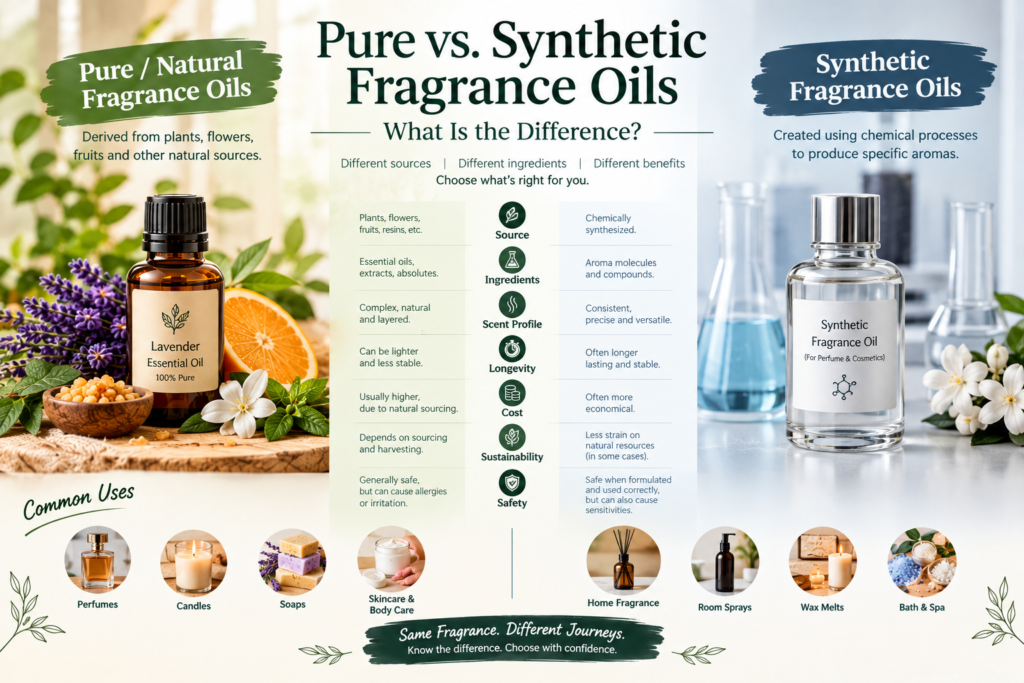
Fragrance plays an important role in perfumes, candles, soaps, skincare products, room fresheners, and personal-care products. Walk into a perfume store, light a scented candle, or open a bottle of body lotion, and fragrance is often one of the first things you notice.
But where does that fragrance come from?
Some fragrances are derived from natural aromatic materials, while others are created using individual aroma molecules produced through chemical processes. There are also products that combine natural and synthetic ingredients to achieve a particular scent profile, performance, or consistency.
This is why understanding pure vs synthetic fragrance oils can be useful when choosing fragrances for personal use, home products, or cosmetic formulations.
The terms “pure,” “natural,” and “synthetic” are sometimes used loosely in marketing, so looking at the actual ingredients and intended use is more helpful than relying on labels alone.
In this guide, we will explore what natural and synthetic fragrance materials are, how they differ, where they are commonly used, their advantages and limitations, and what to consider before choosing one.
What Are Fragrance Oils?
Fragrance oils are aromatic formulations designed to provide a particular scent.
They may contain natural aromatic materials, synthetic aroma compounds, or a combination of both.
The term “fragrance oil” does not automatically mean that a product is natural or synthetic. Its composition depends on how the fragrance has been formulated.
For example, a fragrance designed to smell like vanilla may contain natural vanilla-derived materials, synthetic aroma molecules, or a combination of several ingredients.
Similarly, a floral fragrance may use essential oils, isolates, synthetic molecules, or multiple aromatic materials to create a specific scent.
Understanding pure vs synthetic fragrance oils therefore starts with understanding what ingredients are actually present in a product.
What Are Natural or Plant-Derived Fragrance Materials?
Natural aromatic materials can come from plants and other natural sources.
Essential oils are one example. They are concentrated aromatic extracts obtained from materials such as flowers, leaves, peels, roots, seeds, bark, or other parts of plants.
Other natural aromatic materials include absolutes, resins, extracts, and certain isolates.
For example, lavender essential oil provides a naturally derived lavender aroma, while citrus essential oils can provide bright fruity and fresh notes.
Natural materials can contain many different aromatic compounds, which contribute to their distinctive scent profiles.
What Are Synthetic Fragrance Materials?
Synthetic fragrance materials are aroma compounds produced through chemical processes.
“Synthetic” does not automatically mean unsafe or low quality. Many synthetic aroma molecules are developed specifically for fragrance applications and can undergo safety evaluation and quality control.
Synthetic ingredients can also reproduce aromas that are difficult, expensive, unstable, or environmentally challenging to obtain from natural sources.
For example, a perfumer may use a synthetic molecule to create a particular floral, woody, musky, or fruity note that would be difficult to achieve using natural materials alone.
When discussing pure vs synthetic fragrance oils, it is important not to assume that one category is automatically better in every situation.
Pure Fragrance Oil vs. Essential Oil
Another common source of confusion is the difference between fragrance oil and essential oil.
An essential oil is a concentrated aromatic extract obtained from a plant or botanical source.
A fragrance oil is a broader term that can refer to an aromatic formulation containing synthetic materials, natural materials, or both.
Therefore, not every fragrance oil is an essential oil.
For example, a perfume fragrance designed to smell like fresh rain may not have a direct natural equivalent that can simply be extracted from a plant. A perfumer may instead create the fragrance using several aroma compounds.
This distinction is important when shopping for aromatic products.
Natural Does Not Always Mean Better
When comparing pure vs synthetic fragrance oils, it is tempting to assume that natural products are always superior.
However, “natural” and “synthetic” describe the source or production method of ingredients, not a complete measurement of quality, safety, performance, or suitability.
Natural ingredients can cause allergic or skin reactions in some people.
Some natural materials can also vary in composition depending on plant variety, climate, soil, harvesting conditions, extraction method, and storage.
Synthetic materials, meanwhile, can provide consistency and controlled performance.
The appropriate choice depends on the product, application, formulation, and individual preferences.
Why Natural Fragrance Materials Are Popular
Natural aromatic materials are popular among consumers who prefer plant-derived ingredients.
They can provide complex and distinctive scent profiles.
For example, natural lavender oil contains numerous aromatic constituents that contribute to its characteristic fragrance.
Natural materials can also appeal to people who enjoy botanical products and aromatherapy-inspired experiences.
However, natural materials can sometimes be more expensive or variable than their synthetic counterparts.
Why Synthetic Fragrance Materials Are Popular
Synthetic fragrance materials offer several practical advantages.
Consistency
Synthetic aroma molecules can provide greater consistency from one batch to another.
Variety
Perfumers can create fragrances that do not occur naturally in a single plant.
Stability
Some synthetic materials can provide better stability in certain formulations.
Cost
Certain synthetic ingredients may be more economical than obtaining equivalent natural materials.
Sustainability considerations
Synthetic alternatives can sometimes reduce pressure on plants that are difficult or resource-intensive to cultivate or harvest.
These factors explain why synthetic materials are widely used in modern perfumery and consumer products.
Scent Complexity
One important difference in pure vs synthetic fragrance oils can be the character of the fragrance.
Natural extracts often contain numerous aromatic compounds that work together to produce a complex scent.
Synthetic fragrances can also be highly complex, but their complexity comes from intentionally selected aroma molecules.
A professional perfumer may combine many different ingredients to produce a fragrance with top, middle, and base notes.
Therefore, synthetic does not necessarily mean simple.
Fragrance Longevity
How long a fragrance lasts depends on many factors.
These include:
- Ingredient volatility
- Concentration
- Product formulation
- Surface or skin
- Temperature
- Humidity
- Other ingredients
- Storage conditions
Some natural aromatic materials are highly volatile and disappear relatively quickly.
Certain synthetic aroma molecules may be designed or selected for greater persistence.
This is one reason modern perfumes often use a combination of natural and synthetic materials.
Natural and Synthetic Ingredients Can Work Together
Modern fragrance formulation does not always involve choosing one category over the other.
Many professional fragrances use both natural and synthetic materials.
A perfumer might use natural citrus oil for brightness, a synthetic floral molecule for volume, and a woody aroma molecule for longevity.
This combination allows the perfumer to control the overall scent more precisely.
Understanding pure vs synthetic fragrance oils therefore requires recognizing that natural and synthetic ingredients can complement one another.
Cost Differences
Price is another factor consumers notice.
Natural aromatic materials can sometimes be expensive because they depend on agricultural production and extraction.
The amount of raw plant material required can also vary considerably.
For example, some flowers require large quantities of botanical material to produce relatively small amounts of aromatic extract.
Synthetic ingredients can sometimes be produced more efficiently and consistently, which may reduce costs.
However, price alone does not tell you whether a fragrance is high quality.
Sustainability Considerations
Sustainability is becoming increasingly important in the fragrance industry.
Natural materials depend on crops, land, water, harvesting, and agricultural practices.
Overharvesting certain plants can create environmental concerns.
Synthetic alternatives may reduce pressure on specific natural resources in some cases.
However, synthetic production also requires energy and chemical manufacturing processes.
Therefore, sustainability is more complicated than simply labeling something “natural” or “synthetic.”
Responsible sourcing, manufacturing practices, packaging, transportation, and ingredient selection all matter.
Safety and Skin Sensitivity
Safety should always be considered when using fragrance products.
Both natural and synthetic fragrance materials can potentially cause irritation or allergic reactions in sensitive individuals.
Some essential oils contain naturally occurring compounds that can cause sensitization or irritation.
Synthetic fragrance ingredients can also trigger reactions in susceptible individuals.
This is why appropriate product formulation, concentration, labeling, and usage instructions matter more than simply choosing based on whether an ingredient is natural or synthetic.
If a product causes redness, itching, burning, swelling, or other discomfort, discontinue use.
Fragrance Oils in Perfumes
Perfume is one of the most common applications for fragrance materials.
Perfume formulas often contain a mixture of aromatic ingredients dissolved in alcohol or another suitable base.
Natural essential oils may contribute floral, citrus, herbal, woody, or spicy notes.
Synthetic aroma molecules can provide additional character, stability, diffusion, and longevity.
The combination allows perfumers to create sophisticated fragrance profiles.
This is one of the clearest examples of how pure vs synthetic fragrance oils is not necessarily a simple competition between two categories.
Fragrance Oils in Candles
Fragrance oils are also widely used in scented candles.
Candle fragrances need to perform properly when exposed to heat and mixed with wax.
Some fragrance materials may perform better than others depending on the wax type, concentration, wick, and manufacturing process.
When choosing fragrance oils for candles, always select materials specifically appropriate for candle formulation and follow supplier guidance.
Do not assume that an oil suitable for perfume or skincare is automatically suitable for candles.
Fragrance Oils in Soaps and Body Products
Fragrance is commonly added to soaps, lotions, shower products, and other personal-care products.
However, each application has different formulation and safety requirements.
An ingredient suitable for a diffuser may not be appropriate for direct skin application.
When creating personal-care products, use fragrance materials according to their intended application and supplier safety documentation.
Fragrance Oils for Home Products
Room sprays, wax melts, reed diffusers, and other home-fragrance products can contain a variety of aromatic ingredients.
Consumers often choose products based on scent preference, longevity, and performance.
Natural essential oils can provide botanical aromas, while synthetic fragrance materials can create a much wider variety of scent profiles.
For people interested in pure vs synthetic fragrance oils, home fragrance provides a good example of how both categories can have different practical advantages.
How to Read a Fragrance Label
When buying a fragrance product, do not rely entirely on words such as:
- Pure
- Natural
- Premium
- Luxury
- Clean
- Botanical
These terms can have different meanings depending on the product and market.
Instead, look for clear ingredient information and usage instructions.
For essential oils, botanical names and plant information can be useful.
For formulated fragrance products, ingredient declarations and manufacturer information can provide additional context.
What Does “Natural Fragrance” Mean?
Natural fragrance generally refers to aromatic ingredients derived from natural sources, depending on the applicable standards and labeling requirements.
However, the exact meaning can vary by product category and regulatory framework.
Some products may contain naturally derived aroma ingredients that have been processed or isolated.
Therefore, consumers should look beyond marketing language and check the actual product information.
What Does “Synthetic Fragrance” Mean?
Synthetic fragrance generally refers to aroma ingredients produced through chemical synthesis.
These ingredients may be designed to reproduce natural aromas, create entirely new scent profiles, or improve the performance of a fragrance formula.
Synthetic materials are widely used in modern perfumery because they provide perfumers with a broad palette of scent characteristics.
They can also improve consistency between batches.
Which Should You Choose?
The right choice depends on what you want from a fragrance.
Choose natural aromatic materials if you particularly value:
- Plant-derived ingredients
- Botanical fragrance profiles
- Essential-oil-based aromatherapy
- Natural ingredient preferences
Synthetic fragrance materials may be useful if you value:
- Consistent fragrance
- Broad scent variety
- Long-lasting performance
- Specific fragrance effects
- Cost efficiency
In many products, a combination of both can provide useful characteristics.
The pure vs synthetic fragrance oils decision should therefore be based on the intended application rather than a simple assumption that one category is universally superior.
Common Misconceptions
“Natural means completely safe.”
Not necessarily. Natural substances can still cause irritation or allergic reactions.
“Synthetic means harmful.”
Not necessarily. Synthetic ingredients can be carefully formulated and assessed for intended applications.
“Pure fragrance oil means essential oil.”
Not necessarily. Fragrance oil and essential oil are different product categories.
“Expensive means higher quality.”
Price does not automatically determine quality.
“Synthetic fragrances are always stronger.”
Strength depends on the specific ingredients, concentration, and formulation.
Understanding these points can help consumers make more informed choices.
Tips for Choosing a Fragrance
Before purchasing, consider:
1. Intended use
Is it for perfume, skincare, candles, soap, or home fragrance?
2. Scent preference
Do you prefer floral, citrus, woody, spicy, fresh, or sweet aromas?
3. Ingredients
Check what the product actually contains.
4. Safety information
Look for appropriate directions and precautions.
5. Quality and transparency
Choose brands that provide clear product information.
6. Personal sensitivity
If you are sensitive to fragrances, test products carefully and discontinue use if irritation occurs.
Final Thoughts
Understanding pure vs synthetic fragrance oils can help you make better decisions when shopping for perfumes, home fragrances, personal-care products, candles, and other scented products.
Natural aromatic materials can offer distinctive botanical fragrance profiles, while synthetic aroma materials can provide consistency, variety, stability, and access to scents that may be difficult to obtain naturally.
Neither category should automatically be judged solely by its source.
The most important factors are the intended application, ingredients, formulation, quality, concentration, safety information, and your personal preferences.
If you prefer plant-derived aromas, essential oils and other natural aromatic materials may appeal to you. If you want a highly specific, consistent, or long-lasting fragrance, synthetic materials may offer useful advantages.
In many modern fragrance products, natural and synthetic materials are used together to create balanced and sophisticated results.
Ultimately, learning about pure vs synthetic fragrance oils gives you a better understanding of what is inside the products you use and helps you choose fragrances based on information rather than marketing claims.